


Door Supervisor Training for Romford
Romford has long been one of East London's best-known nights out, with South Street, the market and a busy town centre. That makes it a good place to find door work once you have your SIA licence.
Our Forest Gate centre is direct from Romford on the Elizabeth line, so there is no need to change trains to reach your course.
Getting to class from Romford
Take the Elizabeth line from Romford towards London and stay on until Forest Gate. The journey is direct, with no changes. Our centre is around a 10-minute walk from Forest Gate station.
If you live in Gidea Park, Harold Wood or Chadwell Heath, you are also on the same Elizabeth line, which makes the daily journey simple.
Address
7th Floor, Kalam House, 252–256 Romford Road, Forest Gate, London E7 9HZ. Open in Google Maps
| Coming from | How to get here |
|---|---|
| Romford station | Elizabeth line, direct to Forest Gate, no changes |
| Gidea Park and Harold Wood | Elizabeth line, direct to Forest Gate |
| Chadwell Heath | Elizabeth line, direct to Forest Gate |
| Hornchurch and Upminster | Bus or District line to Romford or Barking, then on to Forest Gate |
Four Mandatory Level 2 Units
The six-day classroom programme follows the SIA and Pearson specifications across four core units:
Unit 1: Principles of Working in the Private Security Industry
- Know the main characteristics and purposes of the private security industry
- Understand legislation as it applies to a security operative
- Understand arrest procedures relevant to security operatives
- Understand the importance of safe working practices
- Understand fire procedures in the workplace
- Understand emergencies and the importance of emergency procedures
- Understand how to communicate effectively as a security operative
- Understand record keeping relevant to the role of the security operative
- Understand terror threats and the role of the security operative in the event of a threat
- Understand how to keep vulnerable people safe
- Understand good practice for post-incident management
Unit 2: Principles of Working as a Door Supervisor in the Private Security Industry
- Understand crimes relevant to door supervision
- Know how to conduct effective search procedures
- Understand drug-misuse legislation, issues and procedures relevant to the role of a door supervisor
- Understand preservation of evidence relevant to the role of a door supervisor
- Understand licensing law relevant to the role of a door supervisor
- Understand queue management and venue capacity responsibilities relevant to a door supervisor
- Know how to use equipment relevant to a door supervisor
Unit 3: Application of Conflict Management in the Private Security Industry
- Understand the principles of conflict management appropriate to the role
- Understand how to recognise, assess and reduce risk in conflict situations
- Understand the use of problem-solving techniques when resolving conflict
- Be able to communicate to de-escalate conflict
Unit 4: Application of Physical Intervention Skills in the Private Security Industry
- Understand physical interventions and the implications of their use
- Understand the risks associated with using physical intervention
- Understand how to reduce the risks associated with physical intervention
- Be able to use physical skills to protect yourself and others
- Be able to use non-pain compliant standing, holding and escorting techniques
Learning outcomes from the Pearson specification for the Pearson BTEC Level 2 Award for Door Supervisors in the Private Security Industry (603/7281/3).
How Each Unit Helps You Work in Romford
Unit 1: Principles of Working in the Private Security Industry
On a Saturday night in Romford town centre, you may need to work with the police after an incident. Unit 1 covers your legal powers, including the rules for making a citizen's arrest.
Unit 2: Principles of Working as a Door Supervisor in the Private Security Industry
South Street venues deal with fake ID and underage customers. Unit 2 covers age checks, refusing entry and the licensing law that protects both you and the venue.
Unit 3: Application of Conflict Management in the Private Security Industry
Someone refused entry may argue on the street outside. Unit 3 teaches de-escalation, so you can end the conversation safely without making the situation worse.
Unit 4: Application of Physical Intervention Skills in the Private Security Industry
When a customer will not leave, Unit 4 covers the safe escorting techniques you can use, and the medical risks, like positional asphyxia, that you must always avoid.
How the Course Is Assessed
| Unit | How it is assessed |
|---|---|
| Unit 1 | 72-question multiple-choice exam (110 minutes, pass mark 70%) plus a short practical task on writing an evidential statement. |
| Unit 2 | 50-question multiple-choice exam (75 minutes, pass mark 70%) plus practical assessments of searching and using a radio. |
| Unit 3 | 20-question multiple-choice exam (30 minutes, pass mark 70%) plus one role-play scenario where you show you can de-escalate. |
| Unit 4 | 30-question multiple-choice exam (45 minutes, pass mark 80%), a practical where you show every technique, and a short question-and-answer session. |
EFAW & Entry Requirements
- You must be 18 or over.
- English at B2 level or equivalent (for example Functional Skills Level 1 English or an ESOL Level 1 qualification). Not sure? Book our free English assessment.
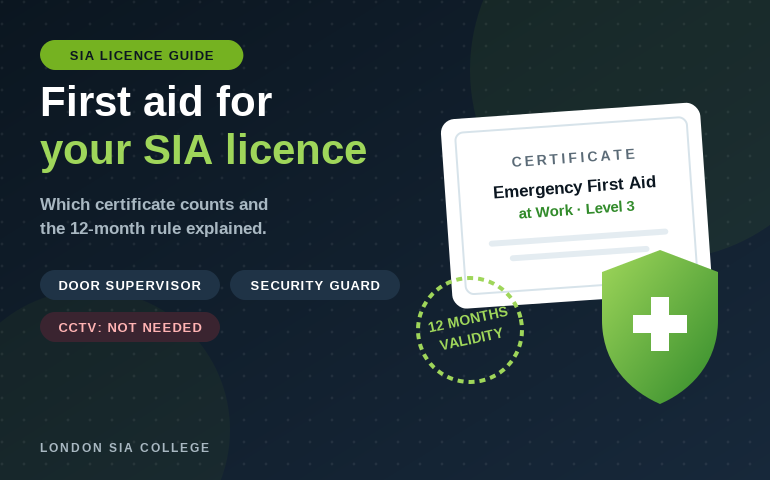
- A valid Emergency First Aid at Work certificate with at least 12 months left on it on your first day. You can book it with us as a bundle.
- Photo ID and proof of address to bring on the first day.
Need first aid? Book Emergency First Aid at Work. Unsure about your English? Take our free English assessment.
Door work in Romford and Havering
Romford's evening economy is centred on South Street and the town centre, and weekends are busy. There is also retail and shopping centre security work during the day.
Bars and late venues on and around South Street
The Liberty and The Brewery shopping areas
Romford Market and town centre events
Venues and events across Havering and Brentwood
Looking for work? Our free CV and job support is open to everyone.
Why Romford learners train with us
Busy nightlife areas need door staff who know licensing law well. Unit 2 covers the licensing rules door supervisors work under, including refusing entry, age checks and dealing with drunk customers.
Training away from your home town can also help. You meet learners from across East London, which is useful when you start looking for shifts at different venues.
Local tip
Romford is towards the end of the Elizabeth line, so trains into London are often quieter in the early morning than at stations further in. A train around 8:00 am gets you to class in good time.
How to Get Your SIA Door Supervisor Badge
Choose your UK city and book
Select a location and course date, pay in full or ask about a deposit, and let us know if you need the First Aid bundle.
Complete training and exams
Attend six days of classroom training, sit the four unit exams and complete the physical intervention assessment.
Apply with free guidance
After your certificate is issued, our team can guide you through the SIA application, identity documents and DBS check.
Receive your licence
Once the SIA approves your application, your licence is issued and you can apply for eligible security roles.
Door Supervisor Courses Nearby
Also available: Stratford, East Ham, Birmingham, Manchester, Liverpool, Glasgow. See all our training locations or the main SIA Door Supervisor course page.
Helpful Guides Before You Book
Questions From Romford Learners
Is there a door supervisor course in Romford?
Our nearest centre is in Forest Gate, direct from Romford on the Elizabeth line with no changes. Many Havering learners train with us there.
How long is the train from Romford?
Romford to Forest Gate is a direct Elizabeth line journey, usually around 15 minutes, plus a short walk to our centre.
Will I learn licensing law for pubs and clubs?
Yes. Unit 2 covers the licensing law that door supervisors work under, including refusing entry, checking age and dealing with customers who have had too much to drink.
How long does it take to get my SIA licence after the course?
After you pass, your certificate is issued and you apply to the SIA online. The SIA also checks your identity and criminal record. Many applications take a few weeks, so apply as soon as you have your certificate.
What happens if I fail an exam?
You normally resit only the unit you did not pass, not the whole course. Ask us about the current resit arrangements before you book.
How long does the licence last?
An SIA Door Supervisor licence lasts three years. To renew it you complete a shorter refresher (top-up) course and hold valid first aid.
Ready to Get Your SIA Door Supervisor Licence?
Check the live dates and price above, or message us and we will help you choose a date. See dates and book online