


Door Supervisor Training for London
London has more pubs, clubs, venues and big events than anywhere else in the UK, and every one of them needs licensed door staff. Our six-day course gives you the qualification you need to apply for your SIA Door Supervisor licence.
You train at our own centre in Forest Gate, East London. It is on the Elizabeth line, so it is quick to reach from the West End, Stratford, Ilford, Romford and most of East London.
Where you train in London
Our London head office and training centre is on the 7th floor of Kalam House on Romford Road. Forest Gate station (Elizabeth line) is around a 10-minute walk away, and buses run along Romford Road between Stratford and Ilford.
Because it is our own building, the same team that takes your booking is there when you arrive. If you have a question about your first aid, your ID or your licence application, you can ask in person.
Address
7th Floor, Kalam House, 252–256 Romford Road, Forest Gate, London E7 9HZ. Open in Google Maps
| Coming from | How to get here |
|---|---|
| Liverpool Street | Elizabeth line to Forest Gate, about 10 to 15 minutes |
| Stratford | Elizabeth line, two stops to Forest Gate |
| Ilford | Elizabeth line, two stops to Forest Gate |
| Romford | Elizabeth line, direct to Forest Gate |
| Barking | Suffragette line to Woodgrange Park, which is on Romford Road |
Four Mandatory Level 2 Units
The six-day classroom programme follows the SIA and Pearson specifications across four core units:
Unit 1: Principles of Working in the Private Security Industry
- Know the main characteristics and purposes of the private security industry
- Understand legislation as it applies to a security operative
- Understand arrest procedures relevant to security operatives
- Understand the importance of safe working practices
- Understand fire procedures in the workplace
- Understand emergencies and the importance of emergency procedures
- Understand how to communicate effectively as a security operative
- Understand record keeping relevant to the role of the security operative
- Understand terror threats and the role of the security operative in the event of a threat
- Understand how to keep vulnerable people safe
- Understand good practice for post-incident management
Unit 2: Principles of Working as a Door Supervisor in the Private Security Industry
- Understand crimes relevant to door supervision
- Know how to conduct effective search procedures
- Understand drug-misuse legislation, issues and procedures relevant to the role of a door supervisor
- Understand preservation of evidence relevant to the role of a door supervisor
- Understand licensing law relevant to the role of a door supervisor
- Understand queue management and venue capacity responsibilities relevant to a door supervisor
- Know how to use equipment relevant to a door supervisor
Unit 3: Application of Conflict Management in the Private Security Industry
- Understand the principles of conflict management appropriate to the role
- Understand how to recognise, assess and reduce risk in conflict situations
- Understand the use of problem-solving techniques when resolving conflict
- Be able to communicate to de-escalate conflict
Unit 4: Application of Physical Intervention Skills in the Private Security Industry
- Understand physical interventions and the implications of their use
- Understand the risks associated with using physical intervention
- Understand how to reduce the risks associated with physical intervention
- Be able to use physical skills to protect yourself and others
- Be able to use non-pain compliant standing, holding and escorting techniques
Learning outcomes from the Pearson specification for the Pearson BTEC Level 2 Award for Door Supervisors in the Private Security Industry (603/7281/3).
How Each Unit Helps You Work in London
Unit 1: Principles of Working in the Private Security Industry
A fire alarm goes off in a packed Soho bar. Unit 1 teaches you how to help clear the building calmly, check toilets and side rooms, and report to the fire service when they arrive.
Unit 2: Principles of Working as a Door Supervisor in the Private Security Industry
On a Friday night in Shoreditch you might refuse entry to someone who is clearly drunk. Unit 2 explains the licensing law behind that decision, so you can say no politely and stay within the rules.
Unit 3: Application of Conflict Management in the Private Security Industry
A group is unhappy about a dress code at a Camden venue. Unit 3 shows you how to keep your voice calm, explain the reason, and offer a way forward before things heat up.
Unit 4: Application of Physical Intervention Skills in the Private Security Industry
If a fight starts on the dance floor, Unit 4 teaches safe ways to separate people and escort someone out without causing injury, and why you should only ever use the force that is truly needed.
How the Course Is Assessed
| Unit | How it is assessed |
|---|---|
| Unit 1 | 72-question multiple-choice exam (110 minutes, pass mark 70%) plus a short practical task on writing an evidential statement. |
| Unit 2 | 50-question multiple-choice exam (75 minutes, pass mark 70%) plus practical assessments of searching and using a radio. |
| Unit 3 | 20-question multiple-choice exam (30 minutes, pass mark 70%) plus one role-play scenario where you show you can de-escalate. |
| Unit 4 | 30-question multiple-choice exam (45 minutes, pass mark 80%), a practical where you show every technique, and a short question-and-answer session. |
EFAW & Entry Requirements
- You must be 18 or over.
- English at B2 level or equivalent (for example Functional Skills Level 1 English or an ESOL Level 1 qualification). Not sure? Book our free English assessment.
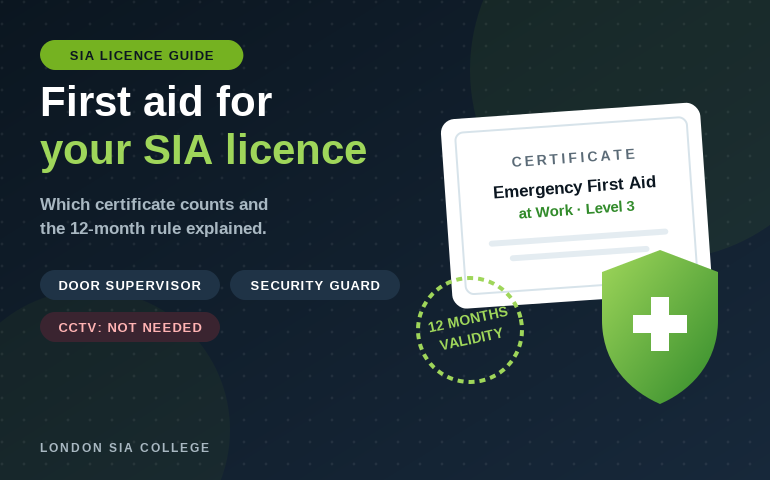
- A valid Emergency First Aid at Work certificate with at least 12 months left on it on your first day. You can book it with us as a bundle.
- Photo ID and proof of address to bring on the first day.
Need first aid? Book Emergency First Aid at Work. Unsure about your English? Take our free English assessment.
Door work in London
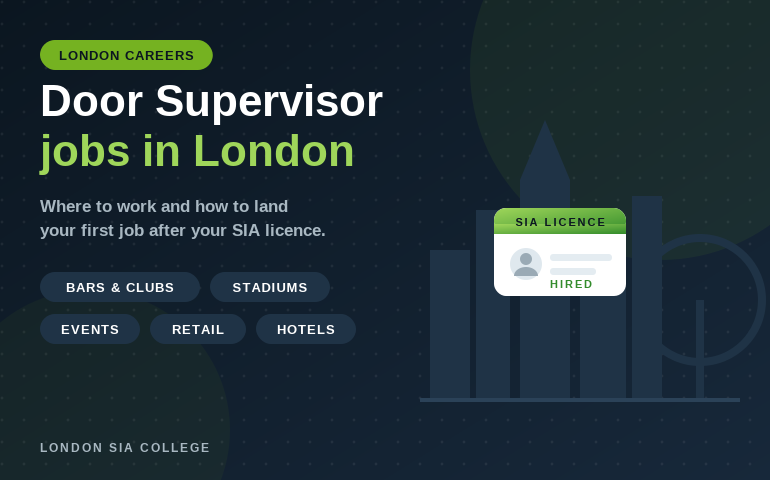
London door supervisors work everywhere from small local pubs to the biggest stages in the country. Weekend and late-night shifts are the most common, but there is steady daytime work too.
Late bars and clubs in Shoreditch, Soho and Camden
Concerts and sport at Wembley, The O2 and London Stadium
Shopping centres such as Westfield London and Westfield Stratford City
Hotels, members' clubs and corporate events across Central London
Looking for work? Our free CV and job support is open to everyone.
Why train in London with us
Most London providers rent hotel rooms for a week at a time. We train in our own centre, so you always know where you are going, and the same staff support you before, during and after the course.
After you pass, our team helps you with your SIA licence application, and our free careers service can help you write a security CV and prepare for interviews.
Local tip
Leave extra time on the first morning. Elizabeth line trains are frequent, but you need to arrive by 9:00 am with your ID and first aid certificate so we can register you before training starts.
How to Get Your SIA Door Supervisor Badge
Choose your UK city and book
Select a location and course date, pay in full or ask about a deposit, and let us know if you need the First Aid bundle.
Complete training and exams
Attend six days of classroom training, sit the four unit exams and complete the physical intervention assessment.
Apply with free guidance
After your certificate is issued, our team can guide you through the SIA application, identity documents and DBS check.
Receive your licence
Once the SIA approves your application, your licence is issued and you can apply for eligible security roles.
Door Supervisor Courses Nearby
Also available: Romford, Barking, Birmingham, Manchester, Liverpool, Glasgow. See all our training locations or the main SIA Door Supervisor course page.
Helpful Guides Before You Book
Questions From London Learners
Where is the London course held?
At our own centre on the 7th floor of Kalam House, 252–256 Romford Road, Forest Gate, London E7 9HZ. Forest Gate station on the Elizabeth line is around a 10-minute walk away.
Is there parking near the London centre?
Parking on Romford Road is limited and some nearby streets are permit-only. Public transport is the easiest way to reach us. If you need to drive, check the local parking signs before you leave your car.
I work during the week. Can I still do the course?
Ask us about weekend and mixed-day dates. The course must cover the full contact hours set by the SIA, so the dates show exactly which days you need to attend.
How long does it take to get my SIA licence after the course?
After you pass, your certificate is issued and you apply to the SIA online. The SIA also checks your identity and criminal record. Many applications take a few weeks, so apply as soon as you have your certificate.
What happens if I fail an exam?
You normally resit only the unit you did not pass, not the whole course. Ask us about the current resit arrangements before you book.
How long does the licence last?
An SIA Door Supervisor licence lasts three years. To renew it you complete a shorter refresher (top-up) course and hold valid first aid.
Ready to Get Your SIA Door Supervisor Licence?
Check the live dates and price above, or message us and we will help you choose a date. See dates and book online