


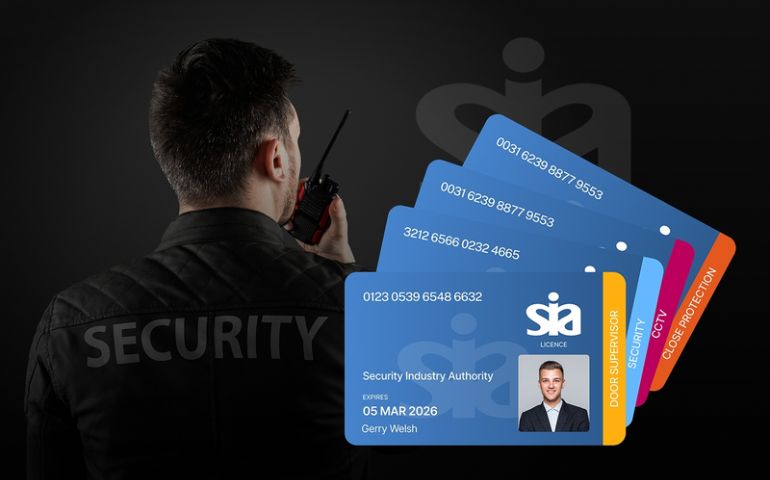
How to Apply for an SIA Licence in 2026: Complete Step-by-Step Guide
If you want to work as a door supervisor, security guard, CCTV operator or close protection operative in the UK, you need the appropriate licence from the Security Industry Authority (SIA). This guide explains the main application steps, current fees, training and document requirements, and how to check the latest official rules before you apply.
SIA requirements can change and an application is not guaranteed to succeed. Use this article as a starting point, then confirm your circumstances directly against the current GOV.UK guidance.
Quick facts (November 2026)
| Item | Current position |
|---|---|
| Licence fee | £204 per licence, since 1 April 2026 |
| Licence validity | 3 years (vehicle immobiliser: 1 year) |
| Minimum age | 18 |
| Additional licence discount | 50% on an additional licence only when included on the same form and submitted the same day |
| Overseas criminal record checks | Required after 6 or more continuous months abroad in the last 10 years |
| Earliest renewal | Up to 4 months before expiry; unused time is added to the new licence |
| Refunds | The application fee is non-refundable |
What has changed since earlier versions of this guide?
Some online guides may still show older fees or licensing rules. The changes highlighted in the supplied November 2026 update include:
- The application fee changed from £184 to £204 on 1 April 2026, when the temporary £20 rebate ended.
- From 1 June 2026, the 50% discount for an additional licence is conditional on including it on the same application form and submitting it on the same day.
- Licensing criteria and the overseas criminal-record check period changed on 1 December 2025; the check can apply after 6 continuous months abroad in the previous 10 years.
- Refresher training is required for door supervisor and security guard renewals, and close protection refresher training became mandatory from 1 April 2026.
- First-aid requirements apply to relevant licence-linked training. Check the current SIA course-specific rules before booking.
- The SIA added the HM Armed Forces Veteran Card to its accepted address-document list.
Step 1: Check that you are eligible
Before paying for training or an application, check that you:
- Are 18 or over.
- Have the right to work in the UK. UK citizens automatically have this right; the SIA checks Home Office records for non-UK citizens. Do not send a share code or BRP unless asked. If the SIA requests evidence, follow its deadline.
- Are likely to meet the SIA's identity, criminality and suitability checks.
- Can provide the requested identity documents and a 5-year address history.
- Hold the correct licence-linked qualification if you are applying for a front-line licence.
Read the SIA's official application guidance before you begin. The application fee is non-refundable.
Step 2: Understand the criminal record rules
Having a criminal record does not automatically mean that you cannot get an SIA licence. The SIA applies licensing criteria to the individual circumstances and the type of information available.
| Decision category | Examples in the current criteria | Possible appeal basis |
|---|---|---|
| Absolute refusal | Specified serious sexual or child abuse/neglect circumstances, including relevant orders or particular offence patterns. | Where the decision relies on incorrect information, such as a record that is not yours. |
| Intention to refuse | Some sexual or child abuse/neglect offences, or a custodial sentence over 48 months. | Incorrect information or evidence that you do not pose a risk to the public. |
| Consider additional factors | A custodial sentence over 12 months. | Incorrect information or evidence that you are fit and proper to hold a licence. |
The relevant-offence list includes areas such as human trafficking and modern slavery, revenge pornography, FGM, domestic abuse, immigration, public order, tax evasion and company law offences. The SIA may also consider other information, including fixed penalty notices, misconduct proceedings or behaviour shown in video footage. If you already hold a licence, current criteria can apply at renewal or if the SIA receives new information. Use the criminal record guidance and indicator before making a decision.
The application asks whether you were compulsorily detained under the Mental Health Act during the previous 5 years. If yes, the SIA may ask for a medical report from a treating psychiatrist, psychologist or regular GP. Follow the current application instructions.
Step 3: Get the right training and first aid
Most front-line applicants must pass an approved licence-linked qualification. The awarding organisation must notify the SIA of your result before you can submit the licence application.
- For a first application, the qualification must generally have been gained within the last 3 years.
- If your previous licence has been inactive for more than 3 years, you may need a new full qualification.
- Door supervisor and security guard learners need the relevant first-aid qualification before training; it must meet the SIA's validity rules.
- Close protection training has its own first-aid requirement. Check the current qualification level directly with the SIA and your approved provider.
- Renewals require the relevant licence-linked refresher qualification. First aid may also need to be current for the refresher course.
Examples of licence-linked qualifications include the Level 2 Award for Working as a Door Supervisor, the Level 2 Award for Working as a Security Officer, and the Level 3 Certificate for Close Protection Operatives. Confirm the exact current qualification title and provider approval before enrolling. Non-front-line and key holding licences do not require a licence-linked qualification.
Provider update: The supplied July 2026 update says Ofqual instructed BIIAB to stop accepting new door supervision and security guarding learners from 2 July 2026, after which the SIA removed BIIAB centres for those courses from its provider search. Check that your chosen provider and awarding organisation are currently approved and accepting learners.
Check the SIA's current training requirements and find an approved provider.
Step 4: Gather your documents
The SIA will tell you which documents it needs to confirm your identity and address. The supplied guide lists one Group A identity document, two Group B address documents (at least one showing your current address), and a passport-style photo. Check the current GOV.UK list before visiting a Post Office.
Group A: proof of identity
The guide lists one eligible identity document, such as:
- A signed, current and valid passport
- A current and valid DVLA photocard driving licence
- A DVA (Northern Ireland) photocard driving licence with its paper counterpart
- A UK original birth certificate issued within 12 months of birth
- A UK adoption certificate
- A UK biometric residence permit card, only if its “valid until” date is less than 15 months ago and it shows “Indefinite leave to remain”, “Indefinite leave to enter” or “No time limit”
Group B: proof of address
The guide lists two eligible address documents, with at least one showing your current address. Examples include:
- Bank or building society statement from the last 3 months
- Utility bill from the last 3 months (not a mobile phone bill)
- Credit card statement from the last 3 months
- Council tax or mortgage statement from the last 12 months
- Letter from HMRC, DWP, Jobcentre Plus or a local authority from the last 3 months
- P45 or P60 from the last 12 months
- Paper version of a current UK driving licence (not the counterpart to a photocard)
- DVA photocard driving licence (not the counterpart)
- Pension, endowment or ISA statement from the last 12 months
- Valid UK firearms licence with a photo
- HM Armed Forces Veteran Card
Document and photo reminders
- The SIA does not normally accept two documents of the same type. It may accept two bank statements from different banks or two credit-card statements from different providers.
- Photocopies, internet-printed statements, branch-printed statements and digital files may not be accepted as originals.
- For documents not in English, provide the original and a translation by an approved translator, arranged and paid for by you.
- If asked to provide a photo, it must be in colour, in focus, a true likeness, show your full head and upper shoulders, use a white or cream background, and not be digitally altered.
See the live SIA identity document guidance for accepted documents and exceptions.
Step 5: Work out the cost
The SIA fee is £204 per licence, paid in full. It is non-refundable, including if an application is refused or cancelled.
| Application | SIA fee example |
|---|---|
| One licence (new or renewal) | £204 |
| Two licences on the same form, same day | £204 + £102 = £306 |
| Second licence applied for on a different day | £204 + £204 = £408 |
| Three licences on the same form, same day | £204 + £102 + £102 = £510 |
The additional-licence discount described in this guide is subject to the same-form, same-day condition. It does not apply to a vehicle immobiliser licence or to renewing the same sector twice. Training and first-aid fees are separate and vary by provider, so request a current quote before booking.
Step 6: Apply for your SIA licence
Option 1: apply yourself
- Create or sign in to your SIA online account through GOV.UK.
- Start a new application, complete all sections and consent to the identity and criminal record checks. The supplied guide describes nine sections; follow the live form if it changes.
- Review all information carefully before submitting. Incorrect or incomplete details can delay an application, and submitted information may not be editable.
- Follow the next-steps instructions and keep your application reference. Applicants in the UK may be directed to a Post Office to show original documents, have a photo taken and pay the fee.
- Check that your chosen Post Office handles SIA applications and respond promptly to requests for further information.
Option 2: apply through your employer
Only an SIA-approved contractor can apply on your behalf. You still need your own SIA account, must link it to the employer's account and must complete the identity checks specified by the SIA. Confirm with your employer who will pay the fee.
If you have lived outside the UK
The SIA may require criminal record evidence for each country where you lived for 6 or more continuous months during the last 10 years. The next-steps message explains what to provide. Check the official overseas-check requirements for your situation.
Step 7: Track the application and wait for a decision
The SIA does not guarantee a processing time. The supplied November 2026 guide cites an internal average target of 10 working days from the “checks in progress” stage for individual applications. This is not a promise and does not include time spent completing your own next steps.
Applications may take longer because of missing information, overseas checks, criminality assessment, right-to-work checks, partner-agency responses, high application volumes or delayed fee payment by an employer. Check your SIA account for messages and status updates, and use the SIA decision timescale indicator for an estimate.
Do not carry out licensable security work until your licence has been granted.
Renewing your SIA licence
- Your licence does not renew automatically. Apply up to 4 months before expiry; any unused time is added to the new licence.
- The renewal fee is the same as a new licence: £204.
- Door supervisors and security guards need the relevant refresher qualification and must meet the applicable first-aid requirement.
- Close protection operatives need the required refresher qualification and applicable first-aid qualification.
- You may need to prove your identity again or attend a Post Office.
- If your licence has expired, you generally need to make a new application rather than renew it.
- Some licence holders may be able to change sectors through the relevant refresher route; check the SIA's current rules for your qualifications and circumstances.
- Renewal is not guaranteed: the SIA applies the criteria current at the time of its decision.
Read the SIA's renewal guidance and check training requirements before booking a refresher.
Martyn's Law and security staff
The Terrorism (Protection of Premises) Act 2025, known as Martyn's Law, received Royal Assent on 3 April 2025. The supplied guide says the Home Office published statutory guidance on 15 April 2026 and commencement is expected in spring 2027, with the exact date to be confirmed by government.
The Act places duties on those responsible for qualifying premises and events, not on individual licence applicants. It is separate from the SIA's individual licensing process and does not change how you apply for a licence today. Consult the current government guidance and updates for commencement and compliance information.
Frequently asked questions
How much is an SIA licence in 2026?
The fee is £204 for one licence, valid for 3 years. A renewal costs the same. Check the current fee on GOV.UK before applying.
Why do some websites still say £184?
That was the rebated fee for applications received before 1 April 2026. The current fee is £204.
Can I get a discount on a second licence?
The 50% additional-licence discount applies only when the extra licence is included on the same application form and submitted on the same day.
Can I pay in instalments or get a refund?
No. The fee must be paid in full and is non-refundable, including if an application is refused or cancelled.
How long does an SIA licence application take?
There is no guaranteed timescale. Use the SIA's decision timescale indicator and apply early, especially when renewing.
Can I apply with a criminal record?
A criminal record does not automatically prevent you from getting a licence. Check the SIA criminal record indicator and current licensing criteria before paying for training.
Do I need first aid training?
Some licence-linked training requires a current first-aid qualification. The required level depends on the licence and course; check the current SIA training guidance.
What if I have lived abroad?
The SIA may require criminal record checks for countries where you lived for 6 or more continuous months during the last 10 years.
Can my employer apply for me?
An SIA-approved contractor can apply on your behalf. You still need your own SIA account and must follow the identity-check instructions.
Explore Related Training
Depending on your goals, you may also want to ask about SIA Door Supervisor, Security Guard, CCTV Operator, Close Protection, refresher or top-up courses.
- Check current entry requirements
- Ask about course fees and availability
- Confirm the training location with the college
Need help choosing SIA training?
London SIA College can help you compare course options and ask about current training dates. Training providers do not decide whether the SIA grants a licence.
Official sources
- Apply for an SIA licence
- Renew your SIA licence
- Check what training you need for an SIA licence
- Check if you can get an SIA licence with a criminal record
- SIA licensing criteria: Get Licensed booklet
- Martyn's Law: official guidance and updates
Fees, documents and licensing rules can change. This guide reflects the supplied update dated 19 November 2026. Always confirm details on GOV.UK before applying.
Send Your Comment
Your email address will not be published. Required fields are marked *