


Door Supervisor Training for Glasgow
Glasgow has one of the UK's busiest nightlife scenes and hosts major concerts and football every week. The SIA licence is a UK-wide licence, so the same Door Supervisor licence lets you work in Scotland.
We have a local office in Glasgow city centre, so you can speak to someone in the city about your course and your licence application.
Our Glasgow office and venue
Our Glasgow office is on the 2nd floor of Ingram House, 227 Ingram Street, in the Merchant City. Glasgow Queen Street and Glasgow Central stations and Buchanan Street subway station are all within walking distance.
The course venue for your dates is confirmed when you book, along with the start time and what to bring on day one.
Address
2nd Floor, Ingram House, 227 Ingram Street, Glasgow G1 1DA. Open in Google Maps
| Coming from | How to get here |
|---|---|
| Glasgow Queen Street | A short walk to Ingram Street |
| Glasgow Central | Trains from across the west of Scotland |
| Buchanan Street subway | The Glasgow Subway loop |
| Paisley, East Kilbride and Hamilton | Regular trains into Glasgow Central |
Four Mandatory Level 2 Units
The six-day classroom programme follows the SIA and Pearson specifications across four core units:
Unit 1: Principles of Working in the Private Security Industry
- Know the main characteristics and purposes of the private security industry
- Understand legislation as it applies to a security operative
- Understand arrest procedures relevant to security operatives
- Understand the importance of safe working practices
- Understand fire procedures in the workplace
- Understand emergencies and the importance of emergency procedures
- Understand how to communicate effectively as a security operative
- Understand record keeping relevant to the role of the security operative
- Understand terror threats and the role of the security operative in the event of a threat
- Understand how to keep vulnerable people safe
- Understand good practice for post-incident management
Unit 2: Principles of Working as a Door Supervisor in the Private Security Industry
- Understand crimes relevant to door supervision
- Know how to conduct effective search procedures
- Understand drug-misuse legislation, issues and procedures relevant to the role of a door supervisor
- Understand preservation of evidence relevant to the role of a door supervisor
- Understand licensing law relevant to the role of a door supervisor
- Understand queue management and venue capacity responsibilities relevant to a door supervisor
- Know how to use equipment relevant to a door supervisor
Unit 3: Application of Conflict Management in the Private Security Industry
- Understand the principles of conflict management appropriate to the role
- Understand how to recognise, assess and reduce risk in conflict situations
- Understand the use of problem-solving techniques when resolving conflict
- Be able to communicate to de-escalate conflict
Unit 4: Application of Physical Intervention Skills in the Private Security Industry
- Understand physical interventions and the implications of their use
- Understand the risks associated with using physical intervention
- Understand how to reduce the risks associated with physical intervention
- Be able to use physical skills to protect yourself and others
- Be able to use non-pain compliant standing, holding and escorting techniques
Learning outcomes from the Pearson specification for the Pearson BTEC Level 2 Award for Door Supervisors in the Private Security Industry (603/7281/3).
How Each Unit Helps You Work in Glasgow
Unit 1: Principles of Working in the Private Security Industry
Large events at the OVO Hydro and Hampden need staff who know emergency procedures. Unit 1 covers evacuation, emergency exits and how to support the emergency services.
Unit 2: Principles of Working as a Door Supervisor in the Private Security Industry
Sauchiehall Street venues often check ID at the door. Unit 2 covers the licensing rules, age checks and how to refuse entry in a fair and lawful way.
Unit 3: Application of Conflict Management in the Private Security Industry
On Old Firm days, some customers may be looking for an argument. Unit 3 teaches you to stay neutral, keep calm and stop small problems from growing.
Unit 4: Application of Physical Intervention Skills in the Private Security Industry
If you need to separate two people in a busy bar, Unit 4 covers safe, non-pain-compliant techniques that keep everyone as safe as possible.
How the Course Is Assessed
| Unit | How it is assessed |
|---|---|
| Unit 1 | 72-question multiple-choice exam (110 minutes, pass mark 70%) plus a short practical task on writing an evidential statement. |
| Unit 2 | 50-question multiple-choice exam (75 minutes, pass mark 70%) plus practical assessments of searching and using a radio. |
| Unit 3 | 20-question multiple-choice exam (30 minutes, pass mark 70%) plus one role-play scenario where you show you can de-escalate. |
| Unit 4 | 30-question multiple-choice exam (45 minutes, pass mark 80%), a practical where you show every technique, and a short question-and-answer session. |
EFAW & Entry Requirements
- You must be 18 or over.
- English at B2 level or equivalent (for example Functional Skills Level 1 English or an ESOL Level 1 qualification). Not sure? Book our free English assessment.
- A valid Emergency First Aid at Work certificate with at least 12 months left on it on your first day. You can book it with us as a bundle.
- Photo ID and proof of address to bring on the first day.
Need first aid? Book Emergency First Aid at Work. Unsure about your English? Take our free English assessment.
Door work in Glasgow
Glasgow's city centre is busy seven nights a week, and the city's arenas and stadiums bring in big crowds for concerts and football.
Bars and clubs on Sauchiehall Street and in the Merchant City
Concerts at the OVO Hydro
Football at Hampden Park, Celtic Park and Ibrox
Shopping on Buchanan Street and at St Enoch Centre
Looking for work? Our free CV and job support is open to everyone.
Why Glasgow learners book with us
Our Merchant City office is in the middle of one of Glasgow's busiest nightlife areas, and our local team can help you before and after the course.
Big-event work in Glasgow means large crowds. Unit 1 covers emergencies, evacuation and terror threat awareness, and Unit 2 covers searching and venue capacity, which event employers look for.
Local tip
On Old Firm and big concert days, the subway and city-centre streets get very busy in the evening. Check what is on during your course week and plan your journey home early.
How to Get Your SIA Door Supervisor Badge
Choose your UK city and book
Select a location and course date, pay in full or ask about a deposit, and let us know if you need the First Aid bundle.
Complete training and exams
Attend six days of classroom training, sit the four unit exams and complete the physical intervention assessment.
Apply with free guidance
After your certificate is issued, our team can guide you through the SIA application, identity documents and DBS check.
Receive your licence
Once the SIA approves your application, your licence is issued and you can apply for eligible security roles.
Door Supervisor Courses Nearby
Also available: Stratford, Ilford, Romford, East Ham, Barking, Birmingham. See all our training locations or the main SIA Door Supervisor course page.
Helpful Guides Before You Book
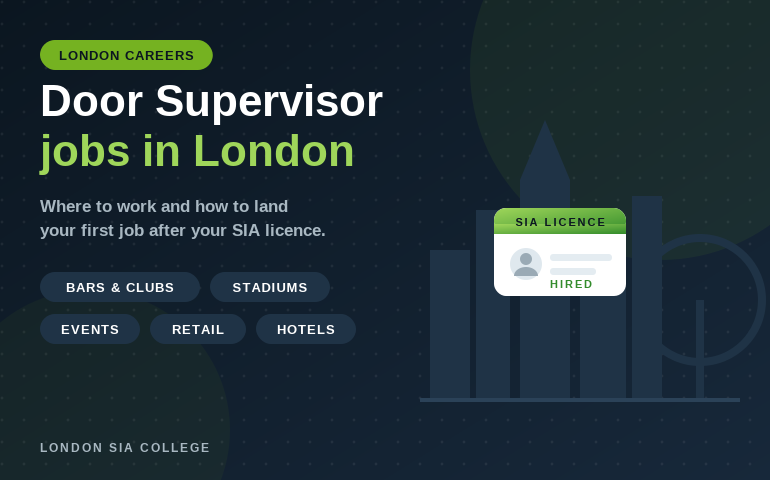
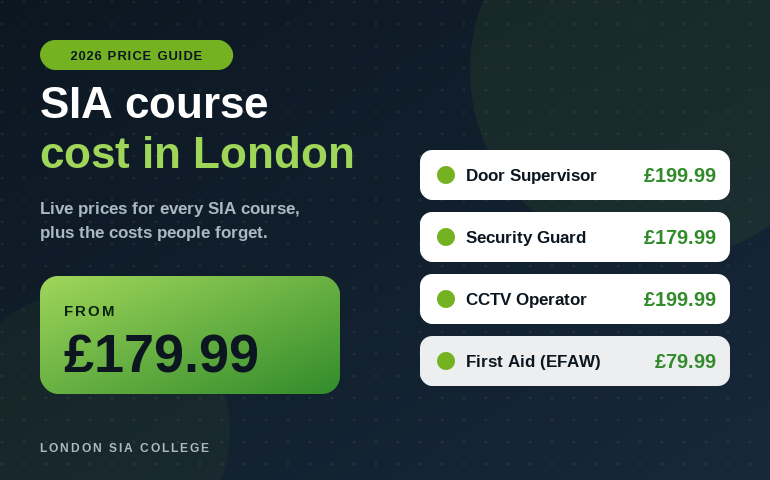
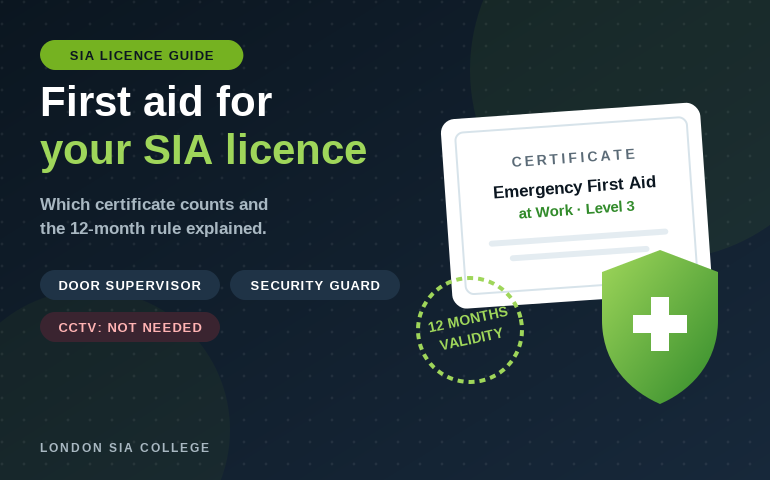
Questions From Glasgow Learners
Is the SIA licence valid in Scotland?
Yes. The SIA licenses door supervisors across the UK, including Scotland, so a Door Supervisor licence lets you work in Glasgow and the rest of Scotland.
Do you have an office in Glasgow?
Yes. Our Glasgow office is on the 2nd floor of Ingram House, 227 Ingram Street, Glasgow G1 1DA. The course venue for your dates is confirmed when you book.
Can I travel in from Paisley or East Kilbride?
Yes. Both have regular trains into Glasgow Central, a short walk from the city centre.
How long does it take to get my SIA licence after the course?
After you pass, your certificate is issued and you apply to the SIA online. The SIA also checks your identity and criminal record. Many applications take a few weeks, so apply as soon as you have your certificate.
What happens if I fail an exam?
You normally resit only the unit you did not pass, not the whole course. Ask us about the current resit arrangements before you book.
How long does the licence last?
An SIA Door Supervisor licence lasts three years. To renew it you complete a shorter refresher (top-up) course and hold valid first aid.
Ready to Get Your SIA Door Supervisor Licence?
Check the live dates and price above, or message us and we will help you choose a date. See dates and book online