


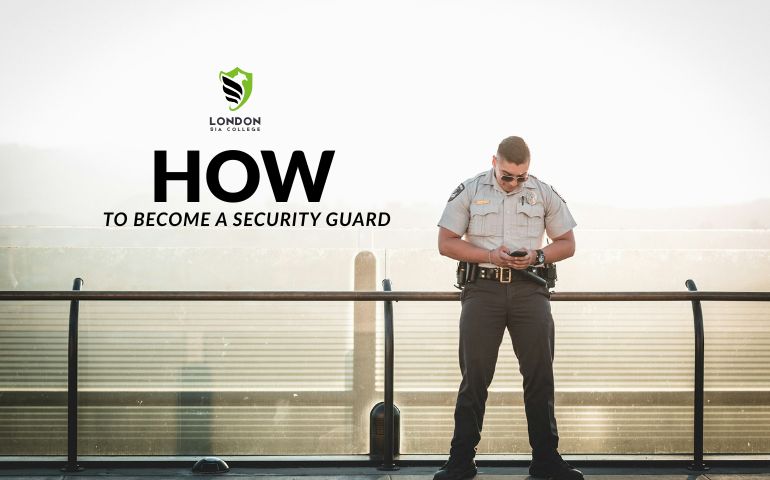
How to Become a Security Guard in the UK: Step-by-Step Guide (2026 and 2027)
To work as a security guard in the UK, you need an SIA security guarding licence. The route is to pass an approved Level 2 qualification, hold valid first aid training, apply to the Security Industry Authority and pay the £204 licence fee. This guide covers the current steps, costs and the changes being planned for 2027.
Planning to start in 2027? The current qualification remains the route to a licence today. The SIA plans to launch revised licence-linked qualifications later in 2027, and the National Living Wage will rise to £13.21 an hour from 1 April 2027. Check the final qualification rules before booking.
Quick facts (November 2026)
| Item | Current position |
|---|---|
| Licence you need | SIA security guarding licence (front line) |
| Minimum age | 18 |
| Qualification | Level 2 Award for Working as a Security Officer in the Private Security Industry |
| First aid | Emergency First Aid at Work or equivalent, valid for at least 12 more months |
| SIA licence fee | £204, valid for 3 years |
| 2026 minimum wage | £12.71 per hour aged 21+; £10.85 aged 18 to 20 |
| 2027 minimum wage | £13.21 per hour aged 21+; £11.27 aged 18 to 20 |
| New qualifications | The SIA plans to launch revised security guard qualifications later in 2027 |
Do you need a licence to work as a security guard?
Yes. Carrying out manned guarding without an SIA licence is an offence when the work is licensable. A person generally needs a licence when they perform the activity under a contract for services and carry out licensable guarding duties.
You do not need previous security experience to enter the sector. The standard route is training, a licence application and approval by the SIA.
Step 1: Check you meet the basic requirements
- Age: you must be at least 18.
- Right to work: UK citizens do not normally need to provide additional evidence. The SIA checks Home Office records for non-UK citizens and may ask for evidence if more information is needed.
- Address history: provide every address you have lived at for the last five years.
- Criminal record: pass the SIA's criminal record checks. A record does not automatically stop an application. Use the SIA criminal record indicator before paying for training.
- Time abroad: if you lived outside the UK for six or more continuous months in the last ten years, you may need an overseas criminal record check for each country.
- English: the SIA requires licence holders to communicate effectively in English.
Step 2: Get your first aid qualification
You must hold an Emergency First Aid at Work qualification, or an equivalent accepted by the SIA, before starting security guard training. It must be valid for at least another 12 months when you begin training.
The SIA does not verify first aid certificates itself, so your approved training provider must check the certificate before enrolment. Some providers offer first aid and the security officer qualification together.
Step 3: Pass the licence-linked qualification
The current qualification is the Level 2 Award for Working as a Security Officer in the Private Security Industry. It must be awarded by an SIA-approved awarding organisation and delivered through an approved training provider.
Pearson's current version provides 38 guided learning hours and 42 total qualification hours. It uses knowledge units assessed by multiple-choice examinations, with course length and format determined by the provider.
Choosing a provider
- Use an approved provider listed in the SIA provider search.
- Confirm that the provider and awarding organisation are accepting learners.
- Ask for a written timetable, assessment process and full quote.
- Be cautious of unusually cheap courses or claims of a guaranteed pass.
- First-time applicants must normally gain the qualification within the last three years.
After you pass, the awarding organisation notifies the SIA. Do not submit or continue the licence application until that notification has arrived.
Step 4: Gather your documents
You will usually need one Group A identity document, two Group B documents showing your address history and a passport-style photo. At least one address document must show your current address.
Typical Group A identity documents
- Signed passport
- DVLA or DVA photocard driving licence
- UK birth certificate issued within 12 months of birth
- UK adoption certificate
- UK biometric residence permit showing indefinite leave or no time limit
Typical Group B address documents
- Bank or building society statement, dated within the last three months
- Utility bill, dated within the last three months
- Council tax or mortgage statement, dated within the last 12 months
- HMRC, DWP or local authority letter, dated within the last three months
- P45, P60, pension or ISA statement
- UK firearms licence or HM Armed Forces Veteran Card, where eligible
Printed-from-the-internet statements and photocopies are not normally accepted. Check the live Apply for an SIA licence page before visiting the Post Office.
Step 5: Apply for your SIA licence
- Create a free SIA online account and start a new application for the security guarding sector.
- Complete all nine sections, including consent to identity and criminal record checks and the declaration.
- Review everything carefully before submitting. Your information may not be editable after submission.
- Follow the next-steps message. In the UK, you will usually go to a Post Office to show original documents and have a photo taken.
- Pay the £204 fee in full. It is non-refundable if the application is refused or cancelled.
If an employer or back-to-work scheme is paying, link your account to theirs. Only an SIA approved contractor can apply on your behalf, and you must still complete the required identity checks.
Step 6: Wait for your decision and do not work yet
The SIA does not guarantee a processing time. Its 2026 to 2027 target is an average of 10 working days from the checks-in-progress stage, but the clock starts after you complete your next steps.
Use the decision timescale indicator and track updates in your SIA account. Missing documents, overseas checks or additional suitability checks can extend the process.
Do not work as a security guard until the licence has been granted. Once granted, the licence is a plastic card that must normally be worn visibly at work.
What it costs: the maths
| Cost | Amount | Notes |
|---|---|---|
| SIA licence fee | £204 | Non-refundable and valid for 3 years |
| Training course | Varies | Ask for a written quote |
| First aid | Varies | Required before licence-linked guard training |
| Photo or documents | Small, if any | A Post Office may take and verify the photo |
The £204 licence fee is valid for three years, so it works out at about £68 a year. At the £12.71 National Living Wage in force from April 2026, this is roughly 16 hours of work before tax. At the 2027 rate of £13.21, it is about 15.4 hours before tax.
Pay is set by employers, not by the SIA. There is no official SIA pay scale and employers must follow the minimum wage applicable to the worker's age.
If you add a second licence, both licences must be on the same application form and submitted on the same day to receive the 50% discount for the additional licence. For example, two licences are £306 together (£204 + £102), instead of £408 if submitted separately.
SIA licence changes in 2027
The SIA is revising all licence-linked qualifications. It held a consultation that closed on 23 October 2026 and expected to publish final specifications in winter 2026, with revised qualifications planned for later in 2027. These proposals may change until final rules are published.
- First aid may become a licence condition for guards, door supervisors and close protection operatives, alongside a security-specific first aid qualification.
- A separate English language test may be added.
- Conflict-management training may include more realistic scenarios.
- New incident reporting and crime scene preservation content may be added.
- Courses may cover Martyn's Law, drug use, spiking, wheelchair and mobility-device searches, social media auditing and drones.
- Counter-terrorism awareness may be refreshed in a single learning package.
- A proposed advanced physical intervention standard may become voluntary or compulsory after licence.
Pearson lists 31 March 2027 as the last registration date for its current security officer version. If you plan to train, confirm the course version, timetable and transition arrangements directly with your provider and awarding organisation.
After you are licensed: renewal and next steps
- Your licence does not renew automatically. You can apply up to four months before expiry.
- Any time left on an existing licence is added to the new licence.
- Security guard renewal requires the Level 2 Award for Security Officers refresher and current Emergency First Aid at Work training.
- Pearson's refresher qualification is 7 guided learning hours.
- The renewal fee is £204.
- A door supervisor can move to a security guard licence through the relevant guard refresher route.
- Renewal is subject to the SIA's criteria, including the changes introduced on 1 December 2025.
Frequently asked questions
How much does it cost to become a security guard?
The SIA fee is £204. Training, first aid and document costs are additional and vary by provider.
How long does it take?
The Pearson qualification is 38 guided learning hours, although course formats vary. The SIA processing time is not guaranteed and depends on your own next steps and checks.
Do I need experience?
No. You need the approved qualification, first aid, identity and criminality checks, and a granted SIA licence.
Can I work while my application is pending?
No. You must not carry out licensable security work until the SIA grants the licence.
Can I become a security guard at 17?
No. You must be 18 or over to hold an SIA licence.
Can I apply with a criminal record?
Often yes, but not always. Use the SIA criminal record indicator before paying for training.
How long does the licence last?
Three years.
Should I wait until 2027 to train?
The current qualification is available today. Providers may also offer a revised qualification later in 2027, so confirm which version you will take.
How much is an SIA licence in 2027?
£204 is the fee at the time of writing. Check GOV.UK for the latest fee before you apply.
Explore Related Training
Depending on your goals, you may also want to ask about SIA Door Supervisor, CCTV Operator, Close Protection, refresher or top-up courses.
- Check current entry requirements
- Ask about course fees and availability
- Confirm the training location with the college
Ready to start your training?
London SIA College can help you choose the right course and plan your first aid and SIA application.
Sources
- Apply for an SIA licence
- Renew your SIA licence
- Check what training you need
- SIA training guidance
- Changes to SIA fees
- SIA criminal record guidance
- SIA qualification consultations
- National Minimum and Living Wage rates
- Pearson security officer qualification
Rules, fees and qualifications are set by the SIA and awarding organisations and can change. This guide reflects official information available on 19 November 2026. Confirm details on GOV.UK before applying.
Send Your Comment
Your email address will not be published. Required fields are marked *